
Has the Trend Gone Too Far?
By Njeri Dean
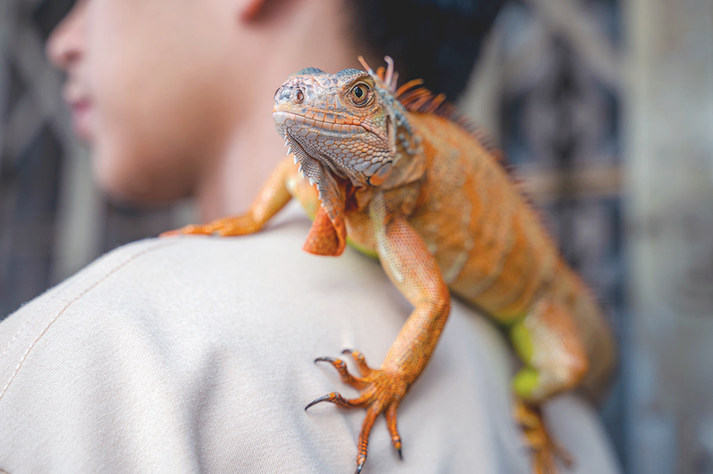
Why is there a man holding a crocodile on a plane that is about to take off? Why is there a miniature horse standing beside a woman in a coffee shop while she sits at a table drinking her morning cup of joe? Most of all, why is there a man perusing the aisles in a bookstore with an iguana on his shoulder?
These are all reasonable questions that people have thought of asking or have asked. They’re trying to understand the evolving phenomena of the emotional support animal.
Apparently dogs aren’t the only ones certified to love. In recent years many reptiles and mammals, foreign and domestic, have been deemed fit to help people who have emotional issues. Many emotional support animals are brought to public places and into situations that are stressful and can trigger their owners to behave out of character or become disruptive. For the majority of people who don’t have an emotional support animal, their presence can be distracting, overwhelming, and purely bothersome.
Most animals are discouraged from public places because they’re viewed as a liability and an obvious health code violation. Exceptions are made for animals in most public places if a person has a disability, including being blind or having a debilitating illness. Having an emotional disorder can disrupt your life, but do you really need an animal—an exotic one for that matter—to regulate your emotions?
Most bystanders who have seen emotional support animals in real life and on TV think they’re absurd and unnecessary to the person they’re helping. Drawing attention in a mostly negative capacity, emotional support animals usually create unwanted attention, health concerns, and safety risks for people who are nearby when the animals are out in public.
The people who acquire these animals often claim the person has a disability and can’t function without them. Performing daily mundane tasks such as getting groceries, flying on airplanes, and other necessary activities that put test their emotional wellbeing is simply not possible without the presence of their animal-kingdom friends.
Has society gone too far? Has it really made people co-dependent on the animal kingdom for survival? What happened to traditional therapy and facing your problems head on?
Why some people pick the oddest animals to be their emotional support animal is anybody’s guess. Knowing that an animal looks strange and might cause a stir is what most people risk when obtaining a support animal that the public is unaware of and deems odd.
There is no such thing as a training program that certifies an animal to be an emotional support animal. The only thing that makes any animal deemed capable of being an emotional support animal is a valid letter from a trained, licensed professional stating that the animal is certified to help their human counterpart. One simple letter lets any animal be taken anywhere the owner desires.
Most people need to realize that we are living in a world where we need to adapt and change with the times. What works for others might not work for another person or group of people. There are some positive aspects of having emotional support animals that nobody ever talks about.
With mental health being a priority to the world today, more people are finding unique and unorthodox ways to regulate and maintain their mental health for a brighter future and to carry on with their everyday lives. Professionals who study mental disorders have found that animals can calm people when it comes to combating mental disorders. Studies have shown that the presence and touch of animals can release endorphins and regulate a person’s mood, therefore putting the body at ease and decreasing stress and triggers that can cause negative side effects when someone lives with a mental disability.
Animals have a sixth sense when it comes to detecting emotions, especially in human beings. With a keen sense of smell and awareness, many animals can predict and detect when a person is uncomfortable and about to have an episode or a mental breakdown. Knowing that a familiar presence, such as an animal, is close can calm and put at ease someone who has an emotional or mental disability.
With the phenomenon not slowing down anytime soon, the world will have to adapt to the animals. Has the craze gone too far? It’s a bit of an annoyance in some people’s point of view. But for those people who have an emotional or mental disorder, it’s a remedy, and it works perfectly.
What can you say? Don’t knock it before you try it.
